


Flanders Cracks Down on Substandard Housing with Significantly Higher Fines
Are you renting out a home with serious quality defects? If so, you risk criminal prosecution. Starting today, penalties for renting substandard housing in Flanders will be significantly increased. A fine can reach up to 800,000 euros under aggravating circumstances. At the same time, judges will have greater discretion to tailor the penalty to the severity of the offense.
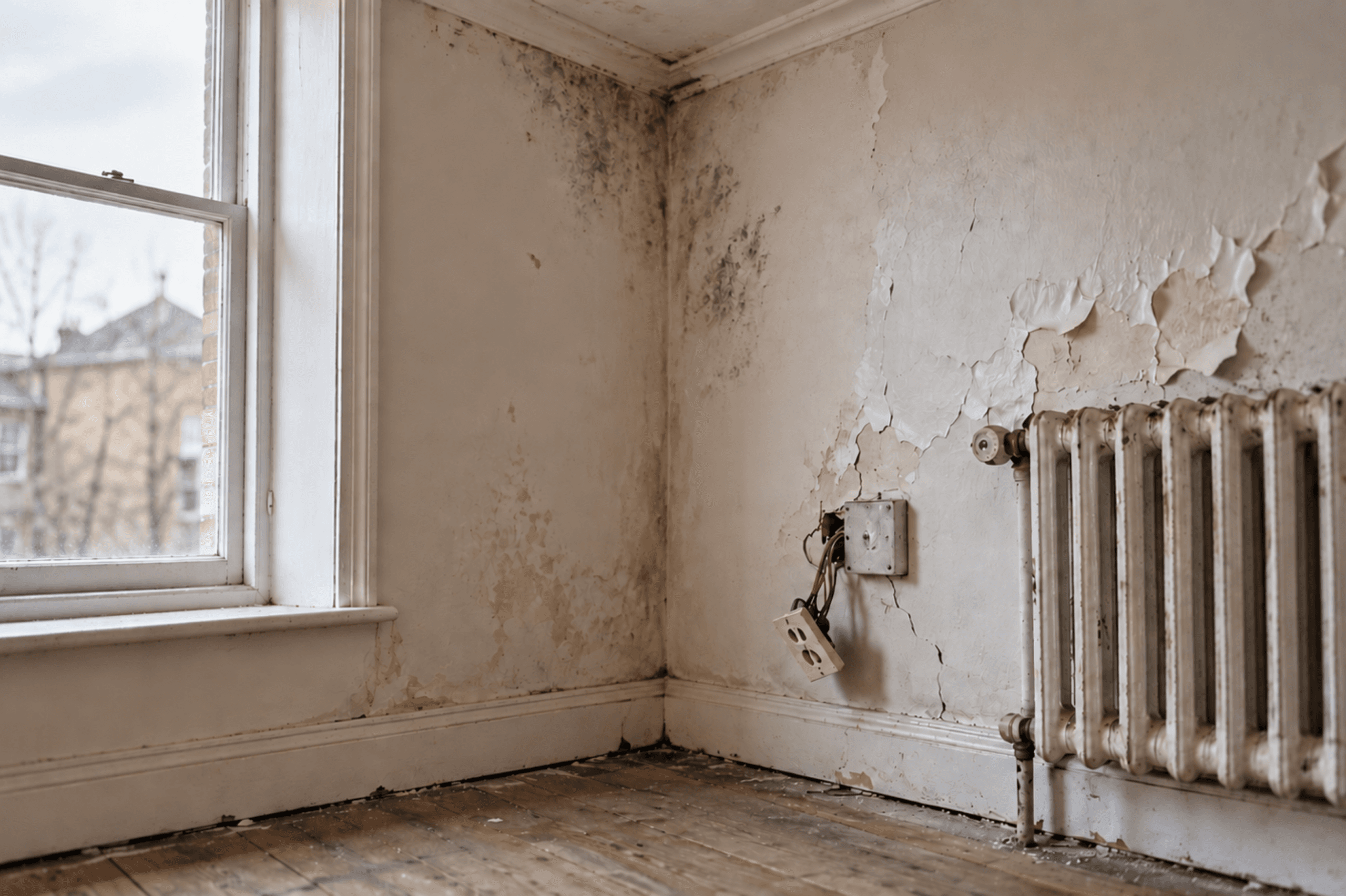
What is substandard housing?
The Flemish Housing Code (‘Vlaamse Codex Wonen’ or VCW) requires every residence to meet minimum quality standards. These include adequate structural stability, fire safety, or a healthy indoor environment.
Anyone who rents out, offers for rent, or makes available a dwelling that does not meet these standards is committing a crime (Articles 3.34 and 3.35 VCW). This is commonly referred to as ‘substandard housing’.
This is not the same as slumlord practices, in which a landlord deliberately exploits a tenant’s vulnerable position. Such a vulnerable position is not required for substandard housing.
Until recently, renting substandard housing was punishable by a prison sentence of six months to three years and a fine of 500 to 25,000 euros, or by one of these penalties alone.
In cases involving aggravating circumstances, such as when the activity had become a habitual practice, the penalty increased to a prison sentence of one to five years. The fine could then range from 1,000 to 100,000 euros.
What is changing today?
The Flesmish decree of June 3, 2026, amending various decrees regarding the second general implementation of the Flemish Enforcement Framework Decree (‘Kaderdecreet Vlaamse Handhaving’ or KVH), takes effect on September 8, 2026. This also revises the penal provisions of Articles 3.34, 3.35, and 3.36 of the VCW.
Penalties will henceforth be expressed according to the new penalty level system of the Penal Code, which was reformed in 2024 and has been in effect since September 1, 2026. Article 36 of the Penal Code sets out the levels for natural persons, while Article 38 of the Penal Code sets out those for legal entities.
In the context of substandard housing rentals, levels 1, 2, and 3 are relevant in each case. For both natural persons and legal entities, the principal penalties can range from a fine to the closure of the establishment or a prison sentence, depending on who is involved.
The basic offense, namely the rental of substandard housing (Articles 3.34 and 3.35 of the VCW), will be punishable by a Level 2 or Level 1 penalty, with the maximum fine always amounting to 200,000 euros. In the case of aggravating circumstances, namely, habitual engagement or participation in an association (Article 3.36 VCW), Level 3 or 1 applies, and the maximum fine is always 800,000 euros.
At the same time, this implies that the legislature has deliberately chosen to give the judge the option, in deviation from the provisions of the Penal Code, to opt for a Level 1 penalty where appropriate, even when a Level 2 or 3 penalty could be imposed. This gives the judge greater discretion to tailor the penalty to the severity of the offense.
What does this mean for you?
Do you rent out properties or advise landlords in Flanders? If so, make sure the property meets the minimum quality standards before you rent it out or make it available.
If you do find yourself involved in a case involving the rental of substandard housing, it is not only the amount of the potential fine that matters. The court has, in fact, been given greater discretion. This can be an important consideration when assessing the criminal risks and formulating a defense in a specific case.
Our specialists at Team Real Estate are happy to assist you with advice on enforcement and liability in real estate leasing.
Discover more about this topic?
I am looking for a specialist in






See more articles

05.10.2026
•NEWS FROM THE FIRM
Luc Herve joins Andersen as the firm opens a new office in Liège
We are pleased to announce that Luc Herve's law firm has joined Andersen in Belgium, which opened a new office in Liège in September. Luc Herve joins Andersen as a Partner, bringing more than thirty years of experience in tax law, alongside his academic work and role as an accredited mediator. He is joined by Jérémy Lerusse, Associate. Both are members of the Liège Bar.

01.10.2026
•Real Estate, Renting and Co-ownership, Andersen in Belgium
New Code of Ethics for Real Estate Agents: More Than a Mere Update
On 21 September 2026, the Royal Decree of 20 July 2026 approving the new Code of Ethics of the Professional Institute of Real Estate Agents (BIV) was published in the Belgian Official Gazette. The new Code enters into force on 1 October 2026, the date on which the 2018 regulations are repealed.

29.09.2026
•Urban Planning and Environmental Law, Andersen in Belgium
Financially contributing to a spatial implementation plan (RUP) poses a risk to your permit
A developer who contributes financially to the drafting of a spatial implementation plan may thereby jeopardize their integrated environmental permit. This follows a ruling by the Council for Permit Disputes dated September 17, 2026. The ruling addresses a practice that is widespread throughout Flanders.

17.09.2026
•Urban Planning and Environmental Law, Andersen in Belgium
Health organisations to become part of the public concerned in urban and environmental permitting procedures
Non-governmental organisations dedicated to protecting human health will soon be able, like environmental protection organisations, to qualify as part of the “public concerned” in urban and/or environmental permitting procedures. This will broaden the range of organisations that may challenge a permitting decision, adding a new dimension to future permitting procedures.